Planning an interstate move can feel overwhelming. Unlike moving across town, relocating to another state involves more than simply packing boxes and hiring movers. You’ll need to manage timelines, update important documents, coordinate utilities, and prepare for life in an entirely new location.
Without a clear plan, it’s easy to overlook important details that can lead to unnecessary stress, delays, or unexpected expenses. That’s why having a detailed interstate moving checklist is one of the smartest ways to stay organized throughout the process.
At Hercules Moving Solutions, we’ve helped coordinate thousands of long-distance relocations by connecting customers with trusted, licensed carriers across the United States. We’ve learned that successful moves aren’t just about transportation—they’re about preparation. The earlier you start planning, the smoother your relocation will be.
This guide provides a complete cross state move checklist, walking you through every stage of your move—from two months before moving day to your first month in your new home. Whether it’s your first interstate relocation or you’ve moved before, following this checklist can help you stay on schedule and avoid common mistakes.
Why Interstate Moves Need Their Own Checklist (Not Just a Generic One)
Moving across state lines is different from moving within the same city.
An interstate relocation involves additional legal requirements, longer transportation schedules, more detailed planning, and greater coordination between multiple service providers.
Instead of focusing only on packing, you’ll also need to think about:
- Choosing a licensed interstate moving company
- Updating your address with multiple agencies
- Registering your vehicle in a new state
- Transferring utilities
- Reviewing insurance policies
- Planning travel arrangements
- Preparing important documents
- Budgeting for additional relocation expenses
Many homeowners underestimate how many moving parts are involved until the final weeks before moving day.
That’s why an organized moving to another state checklist makes such a difference.
Rather than trying to remember dozens of separate tasks, you can work through them one step at a time.
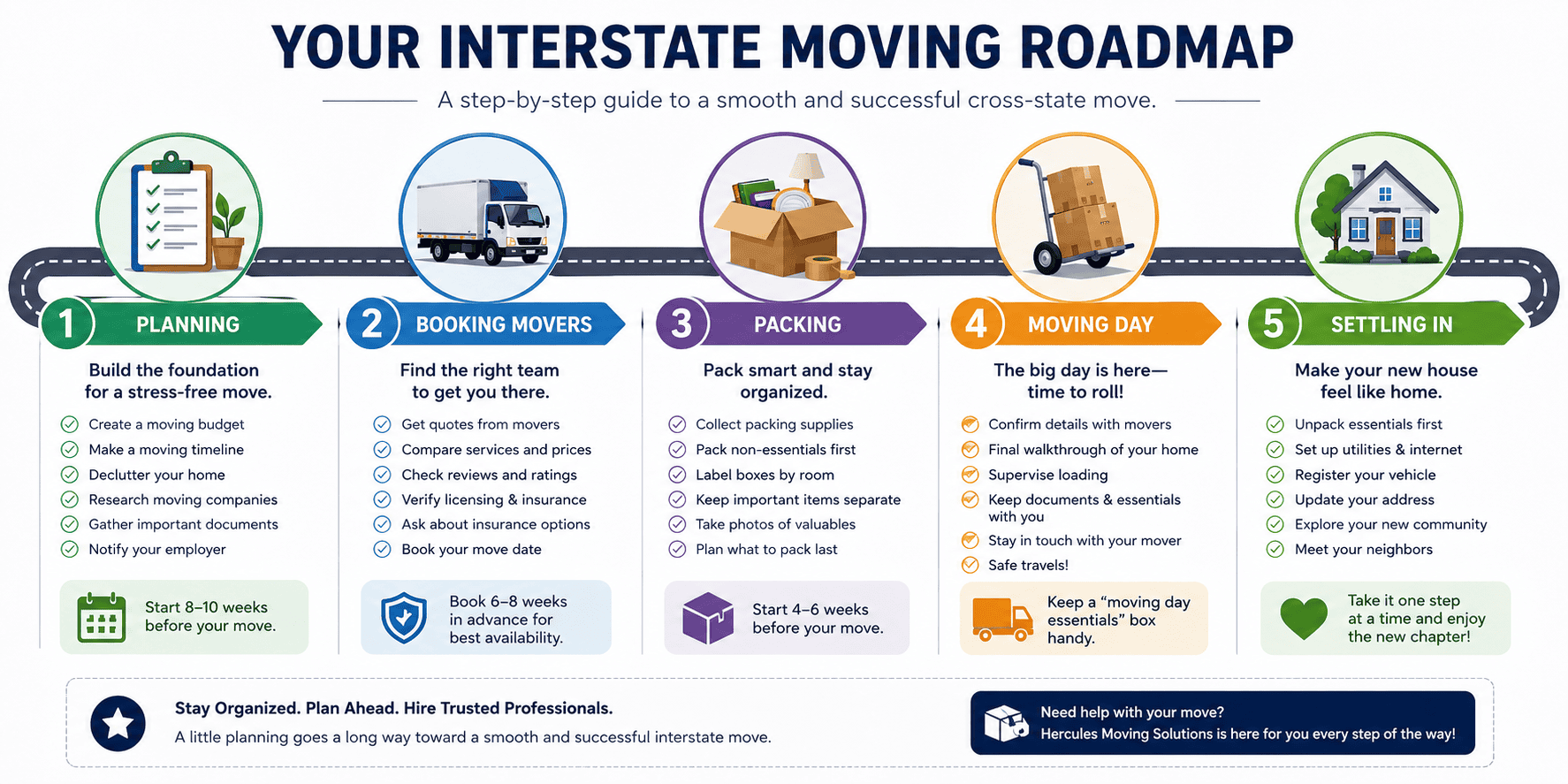
Another benefit of using a dedicated checklist is reducing stress.
When every task has a place on your timeline, you spend less time worrying about what you may have forgotten and more time focusing on preparing for your new home.
Here’s an example of how your planning timeline might look:
| Timeline | Main Focus |
|---|---|
| 60 days before | Budget, research movers, create moving plan |
| 30 days before | Begin packing, transfer utilities, update addresses |
| 2 weeks before | Confirm reservations, finish packing, prepare essentials |
| Moving day | Final walkthrough, supervise loading, keep documents accessible |
| First month after arrival | Register your vehicle, update driver’s license, settle into your new community |
Hiring an Interstate Mover: What to Confirm Before Moving Day
Choosing the right moving company is one of the most important decisions you’ll make during an interstate relocation.
Not all movers offer the same level of service, and the lowest quote isn’t always the best value.
Before booking, make sure you confirm several key details.
Verify licensing and registration
Interstate movers should be registered with the Federal Motor Carrier Safety Administration (FMCSA) and have an active USDOT number.
You can verify a company’s registration through the FMCSA’s Protect Your Move website.
Understand exactly what’s included
Ask questions such as:
- Is the estimate binding or non-binding?
- Are packing materials included?
- What insurance options are available?
- Are fuel surcharges included?
- Are there extra charges for stairs, elevators, or long carries?
- What delivery window should you expect?
Understanding these details ahead of time helps prevent surprises after your belongings are already in transit.
Read customer reviews
Look beyond star ratings.
Pay attention to reviews that mention:
- Communication
- Punctuality
- Damage claims
- Professionalism
- Delivery accuracy
Consistent positive feedback often says more than one unusually glowing review.
Book early whenever possible
Interstate movers often fill their schedules weeks in advance, especially during the busy summer season.
Booking early gives you:
- More available moving dates
- Better pricing opportunities
- Greater carrier availability
- More time to prepare
If you’re comparing different relocation options, our State to State Moving guide explains what to expect during an interstate move and how professional coordination can simplify the process.

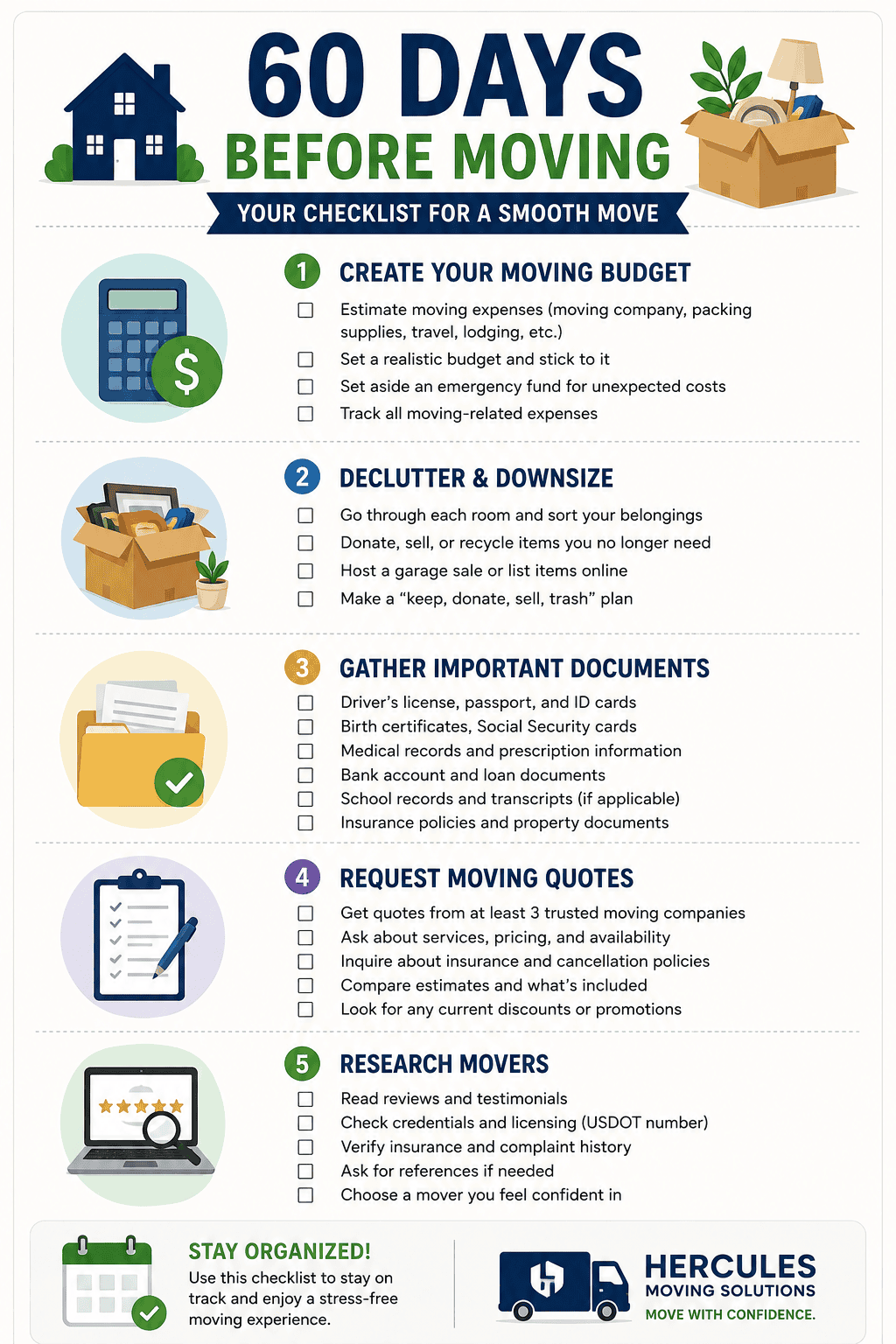
60 Days Before Your Interstate Move
The two-month mark is when your planning should officially begin.
Many of the biggest cost-saving opportunities happen during this stage, while you still have flexibility.
Your priorities should include:
Create your moving budget
List every expected expense, including:
- Professional moving services
- Travel costs
- Hotels
- Fuel
- Meals
- Packing supplies
- Storage (if needed)
- Utility deposits
- Cleaning services
Planning your budget early makes it easier to avoid unexpected expenses later.
Request moving estimates
Avoid choosing the first quote you receive.
Compare several detailed estimates so you understand:
- Pricing
- Included services
- Insurance coverage
- Delivery timelines
Declutter your home
Reducing the amount you move is one of the easiest ways to lower transportation costs.
Go room by room and separate belongings into:
- Keep
- Donate
- Sell
- Recycle
- Dispose
The fewer unnecessary items you move, the less you’ll likely pay.
Start collecting important documents
Create one folder for essential paperwork.
Include items such as:
- Identification
- Birth certificates
- Social Security cards
- Medical records
- School records
- Insurance documents
- Moving contracts
- Financial paperwork
Keep this folder with you rather than packing it inside the moving truck.
Interstate Address Change: DMV, IRS, Voter Registration & More
One of the most overlooked parts of an interstate move is updating your information with government agencies and service providers.
Creating a checklist early helps ensure nothing is missed.
Schedule mail forwarding
Submit a forwarding request through the United States Postal Service (USPS) before moving day so important mail continues reaching you after you relocate.
Update your address with financial institutions
Remember to notify:
- Banks
- Credit card companies
- Investment accounts
- Loan providers
- Retirement accounts
Notify insurance providers
Your move may affect:
- Auto insurance
- Homeowners insurance
- Renters insurance
- Health insurance
Some policies require updates immediately after establishing residency.
Prepare for DMV requirements
Every state has different deadlines for:
- Driver’s license updates
- Vehicle registration
- License plate replacement
- Vehicle inspections
Research your new state’s requirements before moving so you’ll know which documents to bring.
Update voter registration
Most states allow you to register after establishing residency, often while updating your driver’s license.
Completing this step early ensures you’re eligible to vote in future elections.
30 Days Out: Movers, Packing & Logistics
With about one month remaining before your move, it’s time to shift from planning to action. Most of the major decisions should already be made, allowing you to focus on preparing your home, confirming logistics, and staying organized.
Following a structured interstate relocation planning timeline during this stage helps reduce last-minute stress and keeps your move on schedule.
Confirm your moving date
If you haven’t officially booked your movers, now is the time.
Review your moving agreement and verify:
- Pickup date
- Estimated delivery window
- Services included
- Payment schedule
- Contact information
- Insurance coverage
If anything has changed since you received your estimate, notify your moving coordinator as soon as possible.
Begin packing non-essential items
Don’t wait until the final week to start packing.
Begin with items you won’t need before moving day, such as:
- Seasonal clothing
- Holiday decorations
- Books
- Wall décor
- Guest room furniture
- Collectibles
Packing gradually makes the workload much more manageable.
Gather quality packing supplies
Having the right materials protects your belongings during a long-distance move.
You’ll likely need:
- Moving boxes in multiple sizes
- Packing tape
- Bubble wrap
- Packing paper
- Stretch wrap
- Permanent markers
- Labels
Using sturdy boxes designed for moving helps reduce the risk of damage during transportation.
Label every box clearly
A simple labeling system saves hours during unpacking.
Include:
- Room destination
- General contents
- Fragile items
- Priority level
For example:
Kitchen – Plates – Fragile – Open First
Many families also use color-coded labels for each room to make unloading faster.
Packing Timeline for an Interstate Relocation
One of the biggest mistakes people make is trying to pack everything during the last few days before moving.
Breaking the process into weekly goals keeps the workload manageable.
Here’s a sample timeline.
| Time Before Move | What to Pack |
|---|---|
| 4 weeks | Seasonal items, storage rooms, decorations |
| 3 weeks | Books, artwork, collectibles, guest rooms |
| 2 weeks | Extra clothing, office supplies, kitchen items you rarely use |
| 1 week | Most everyday household items |
| Moving day | Essentials box, medications, important documents, valuables |
Don’t forget to prepare an essentials box that stays with you instead of going on the moving truck.
Include items such as:
- Prescription medications
- Chargers
- Toiletries
- Snacks
- Water
- Change of clothes
- Important paperwork
- Pet supplies
- Children’s necessities
Having these items immediately available makes your first day in your new home much more comfortable.
2 Weeks Before Moving Day
By now, your home should already be partially packed, and your relocation plans should be taking shape.
The final two weeks are about confirming details, finishing preparations, and making sure nothing important is overlooked.
Confirm all reservations
Reach out to every company involved in your move and verify:
- Moving company
- Hotel reservations (if applicable)
- Travel arrangements
- Vehicle transportation
- Storage reservations
Double-check addresses, dates, and contact numbers.
Finish packing most belongings
Only everyday essentials should remain unpacked.
As you finish each room:
- Seal every box securely.
- Label all sides.
- Separate fragile items.
- Keep boxes organized by room.
This makes loading and unloading much more efficient.
Dispose of restricted items
Professional interstate movers often cannot transport certain materials.
Common examples include:
- Gasoline
- Propane tanks
- Paint
- Fireworks
- Cleaning chemicals
- Aerosols
- Batteries (certain types)
Check with your moving company for its complete list of prohibited items before moving day.
Prepare appliances
Large appliances may require additional preparation before transportation.
Examples include:
- Disconnecting washing machines
- Defrosting refrigerators and freezers
- Emptying fuel from lawn equipment
- Cleaning outdoor grills
Completing these tasks early prevents delays on moving day.
Interstate Move Day Walkthrough
Moving day arrives faster than most people expect.
Having a simple walkthrough helps ensure everything goes according to plan.
Before the movers arrive
Take a final walk through your home and check:
- Closets
- Cabinets
- Attic
- Basement
- Garage
- Outdoor storage
It’s surprisingly easy to leave something behind.
Keep important items with you
Never load these into the moving truck:
- Passports
- Driver’s licenses
- Birth certificates
- Social Security cards
- Financial records
- Jewelry
- Prescription medications
- Laptops
- Mobile devices
- Chargers
Transport these personally whenever possible.
Review the inventory
Before the truck leaves:
- Compare inventory sheets.
- Ask questions about any unclear entries.
- Photograph valuable items if desired.
- Confirm delivery contact information.
Keeping copies of all paperwork provides peace of mind throughout your relocation.
Perform one final inspection
Before locking the door for the last time:
- Turn off lights.
- Check every room.
- Lock windows.
- Confirm utilities are scheduled correctly.
- Leave keys if required.
Taking just a few extra minutes can prevent forgotten items and unnecessary return trips.
After You Arrive: 30-Day New State Checklist
Congratulations—you’ve made it to your new home. While the hardest part of your interstate move may be over, there are still several important tasks to complete during your first month.
Many people focus so much on getting to their destination that they overlook the steps required to officially establish residency. Completing these tasks early helps you avoid missed deadlines, maintain uninterrupted services, and settle into your new community more quickly.
Use this final section of your interstate moving checklist to stay organized after the moving truck has been unloaded.
Unpack strategically
Instead of trying to unpack your entire home in one weekend, start with the rooms you’ll use most.
A practical order is:
- Bedrooms
- Bathrooms
- Kitchen
- Living room
- Home office
- Storage areas
Prioritizing essential spaces allows your household to return to a normal routine much faster.
Inspect your belongings
As you unpack, compare your shipment with the inventory provided by your moving company.
Look for:
- Missing boxes
- Damaged furniture
- Broken electronics
- Scratched appliances
If you notice any issues, document them immediately with photos and notify your moving company as soon as possible.
Update your driver’s license and vehicle registration
Every state has different deadlines for updating your driver’s license and registering your vehicle after establishing residency.
Generally, you’ll need:
- Proof of your new address
- Current driver’s license
- Vehicle title or registration
- Proof of insurance
- Identification documents
Check your state’s Department of Motor Vehicles (DMV) website for specific requirements and appointment availability.
Confirm your utilities are working properly
Take time during your first few days to verify that all essential services are active.
Check:
- Electricity
- Water
- Gas
- Internet
- Trash collection
- Security systems
If anything isn’t functioning correctly, contact the provider immediately to avoid unnecessary delays.
The First Week in Your New State
Your first week is the perfect time to begin building routines and becoming familiar with your new surroundings.
Locate essential services
Take time to identify nearby:
- Grocery stores
- Pharmacies
- Hospitals
- Urgent care centers
- Gas stations
- Banks
- Post office
- Pet care providers
Saving these locations on your phone makes daily life much easier during your first few weeks.
Meet your neighbors
Introducing yourself to neighbors can help you feel at home more quickly.
Many communities also have:
- Neighborhood social media groups
- Community events
- Local recreation centers
- Volunteer organizations
- Farmers markets
Getting involved early can make your transition much smoother.
Register children for school
If you have school-age children, complete enrollment as soon as possible.
Most districts require:
- Birth certificates
- Immunization records
- Previous school transcripts
- Proof of residency
Having these documents prepared before moving speeds up the enrollment process.
Find new healthcare providers
If you’ve relocated far from your previous providers, begin establishing care with:
- Primary care physician
- Dentist
- Pediatrician
- Specialists
- Veterinarian (if applicable)
Scheduling introductory appointments early helps avoid delays when medical care is needed.
Review your budget
Your first month often includes unexpected expenses.
Examples include:
- Household supplies
- Furniture
- Utility deposits
- Home improvements
- Local registration fees
Review your spending and adjust your budget if necessary.
Ready to Plan Your Interstate Move?
A successful interstate move starts long before moving day. The more organized you are, the easier it becomes to manage packing, paperwork, travel arrangements, and settling into your new home.
At Hercules Moving Solutions, we help simplify long-distance relocations by connecting customers with trusted, licensed carriers across the United States. Whether you’re moving a studio apartment or a large family home, our experienced team is here to guide you through every step of the process.
From planning your timeline to coordinating transportation and answering your questions, we’re committed to making your move as smooth and stress-free as possible.
Request your free quote today and let Hercules Moving Solutions help you plan your interstate move with confidence.
Frequently Asked Questions
What should I do 2 months before an interstate move?
Start by creating a moving budget, researching licensed interstate movers, requesting multiple estimates, decluttering your home, collecting important documents, and building a detailed moving timeline. Beginning early gives you more scheduling flexibility and helps reduce last-minute stress.
How do I update my address when moving to another state?
Submit a mail forwarding request through the United States Postal Service (USPS), then update your address with banks, insurance providers, employers, healthcare providers, subscription services, and government agencies. Once you’ve established residency, update your driver’s license and vehicle registration according to your new state’s requirements.
What is the most important thing to do before moving states?
One of the most important steps is hiring a licensed interstate moving company and creating a comprehensive moving plan. Starting your preparations at least six to eight weeks before moving day gives you enough time to organize documents, compare estimates, and complete administrative tasks.
How do I transfer utilities for an interstate move?
Contact each utility provider several weeks before your move to schedule service disconnection at your current home and activation at your new address. Coordinating these dates carefully helps ensure essential services are available when you arrive.
What documents should I keep with me on moving day?
Keep essential documents with you instead of placing them on the moving truck. These include identification, passports, driver’s licenses, birth certificates, Social Security cards, moving contracts, insurance information, financial records, prescription medications, and valuable personal items.
Conclusion
An interstate move involves much more than packing boxes and traveling to a new address. From hiring the right movers to updating your legal documents and settling into a new community, every stage requires thoughtful planning and organization.
Following a structured interstate moving checklist helps you stay ahead of important deadlines, reduce stress, and avoid common relocation mistakes. Breaking the process into manageable steps allows you to focus on one task at a time instead of trying to handle everything at once.
At Hercules Moving Solutions, we understand that every move is unique. That’s why we work with a nationwide network of trusted, licensed carriers to provide dependable interstate moving solutions tailored to your needs. Whether you’re relocating for work, family, or a fresh start, we’re here to help make your move as smooth as possible.