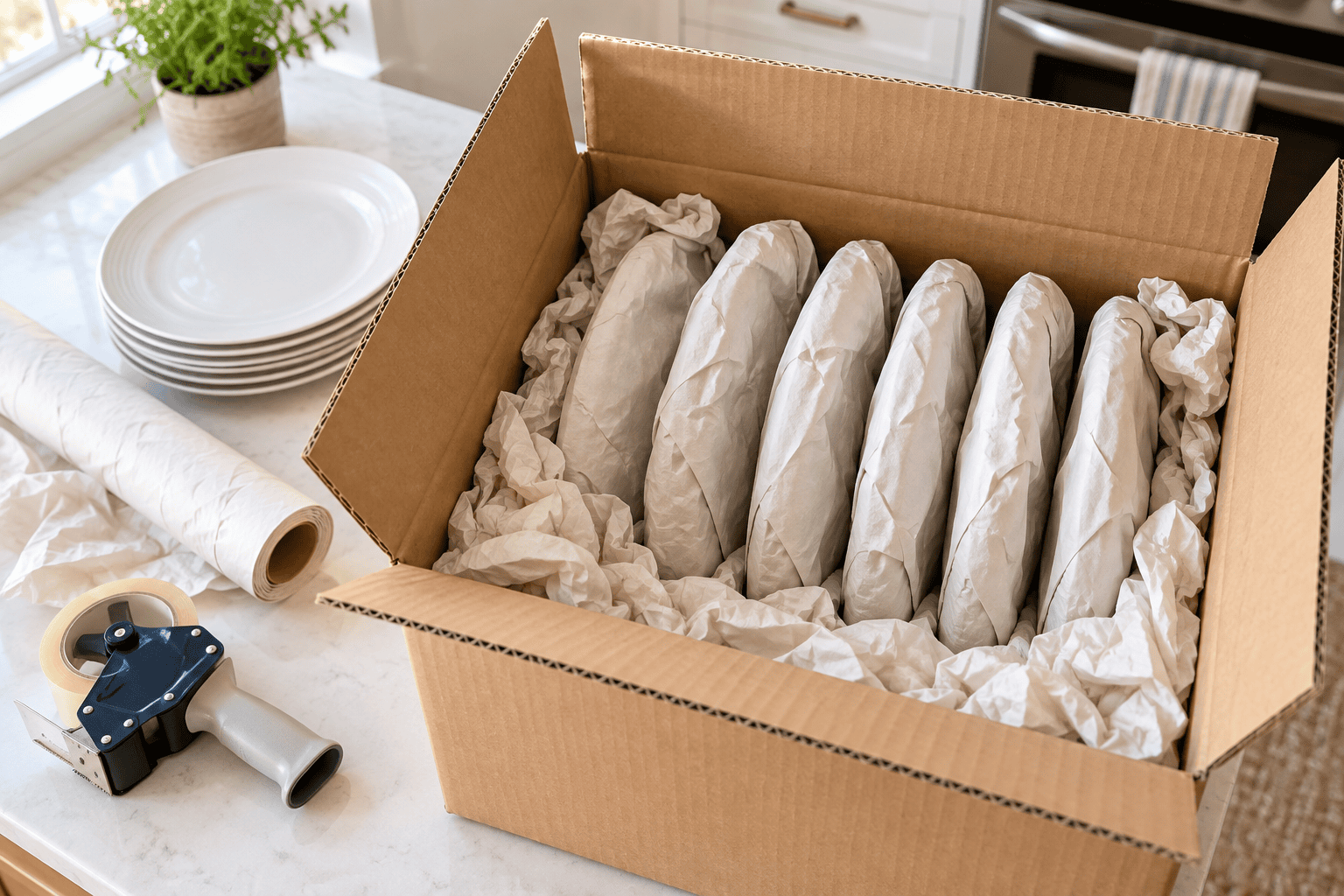
How to pack dishes for moving comes down to four things: a double-wall dish box, a full sheet of paper around every piece, plates standing on their edges rather than lying flat, and no empty space anywhere in the box. Do those four and the box survives a truck. On a long distance move the box also has to survive a shuttle transfer, days of highway vibration, and a second crew unloading it, which is why this guide is written for interstate shipments rather than a trip across town. It also covers something most packing guides skip: what a broken plate is actually worth if you packed it yourself.
Key Takeaways
- Use a dish box, the double-wall carton built for fragile items, and line the bottom with about six inches of crumpled packing paper before anything goes in.
- Wrap every plate, bowl and glass individually. Newspaper ink transfers to dishes, so use plain packing paper.
- Plates go in on their edges, like a dishwasher rack, never stacked flat. Glasses go in upright with the openings stuffed with paper.
- On an interstate move, boxes you pack yourself are harder to claim on if something breaks, and released value protection pays only 60 cents per pound per article.
On This Page
- What You Need Before Packing Dishes for Moving
- How to Pack Plates for Moving: Wrap, Bundle, Stand on Edge
- How to Pack Glasses for Moving, Including Stemware
- Why Packing Matters More on a Long Distance Move Than a Local One
- Frequently Asked Questions
- Decide Now Whether the Kitchen Is Yours to Pack
What You Need Before Packing Dishes for Moving
Packing dishes for moving goes wrong before the first plate is wrapped, because the wrong box is in the room. A standard medium box has single-wall sides. A dish box, sometimes called a dish pack, has a double layer of cardboard in the walls and base, and Home Depot’s packing guide puts a six-inch bed of crumpled paper in the bottom of it before anything else goes in. That wall and that cushion are most of the difference between a kitchen that arrives and one that doesn’t.
For a typical two- to three-bedroom kitchen, plan on:
- Four to six dish boxes, plus one or two medium boxes for pots, plastics and utensils
- Ten to fifteen pounds of plain packing paper. Newspaper ink smudges onto dishes and can react with older glazes on fine china
- Cell dividers or a glass kit for stemware and mugs
- Heavy-duty packing tape, a marker, and a roll of bubble wrap for anything with a stem or a handle
Set a weight limit before you start. Home Depot’s guide says to keep dish boxes under 40 pounds, because a box that’s hard to lift is a box that gets dropped. The NIOSH lifting equation, explained on the Canadian Centre for Occupational Health and Safety’s site, puts the ceiling for a two-handed lift under ideal conditions at about 51 pounds, and a crew member on a staircase is not lifting under ideal conditions. Start the kitchen two weeks before load day, using the pre-move steps in Hercules Moving Solutions’ long distance checklists, and leave one place setting per person out until the last morning.
How to Pack Plates for Moving: Wrap, Bundle, Stand on Edge
Plates and bowls are the heaviest things in the kitchen and the easiest to pack well, so start with them. This is the method a carrier’s packing crew uses, and it works the same for stoneware and wedding china.
- Tape the bottom seam of the dish box, then run a second strip across the middle. Crumple paper into the bottom until the bed is about six inches deep.
- Lay two sheets of packing paper flat, put one plate in the center, and pull each corner over the plate and tuck it in. Set the next plate on top and repeat with fresh paper until you have a bundle of three or four of the same size. Tape the bundle once.
- Stand the bundle on its edge in the box, like loading a dishwasher rack. Never lay plates flat; the weight of the stack above is what cracks the ones on the bottom.
- Put the largest, heaviest plates in first, then salad plates, then bowls. Bowls can be wrapped and nested in twos or threes, then stood on edge the same way.
- Push crumpled paper into every gap between bundles and along the walls. Close the box and shake it gently. If anything shifts, open it and add more paper.
- Add a top layer of paper, seal the box, and mark FRAGILE, THIS SIDE UP and KITCHEN on two sides, because the delivery crew stacks by label.
Platters, serving bowls and glass bakeware get the same wrap but their own box, on edge, with more paper between them. Never nest bare glass bakeware; a sheet of paper between each piece stops the rims chipping each other.
How to Pack Glasses for Moving, Including Stemware
Glasses break differently from plates. A plate cracks under weight from above. A glass shatters when it knocks the glass beside it or when the rim takes a hit, so the method changes from bundling to isolating.
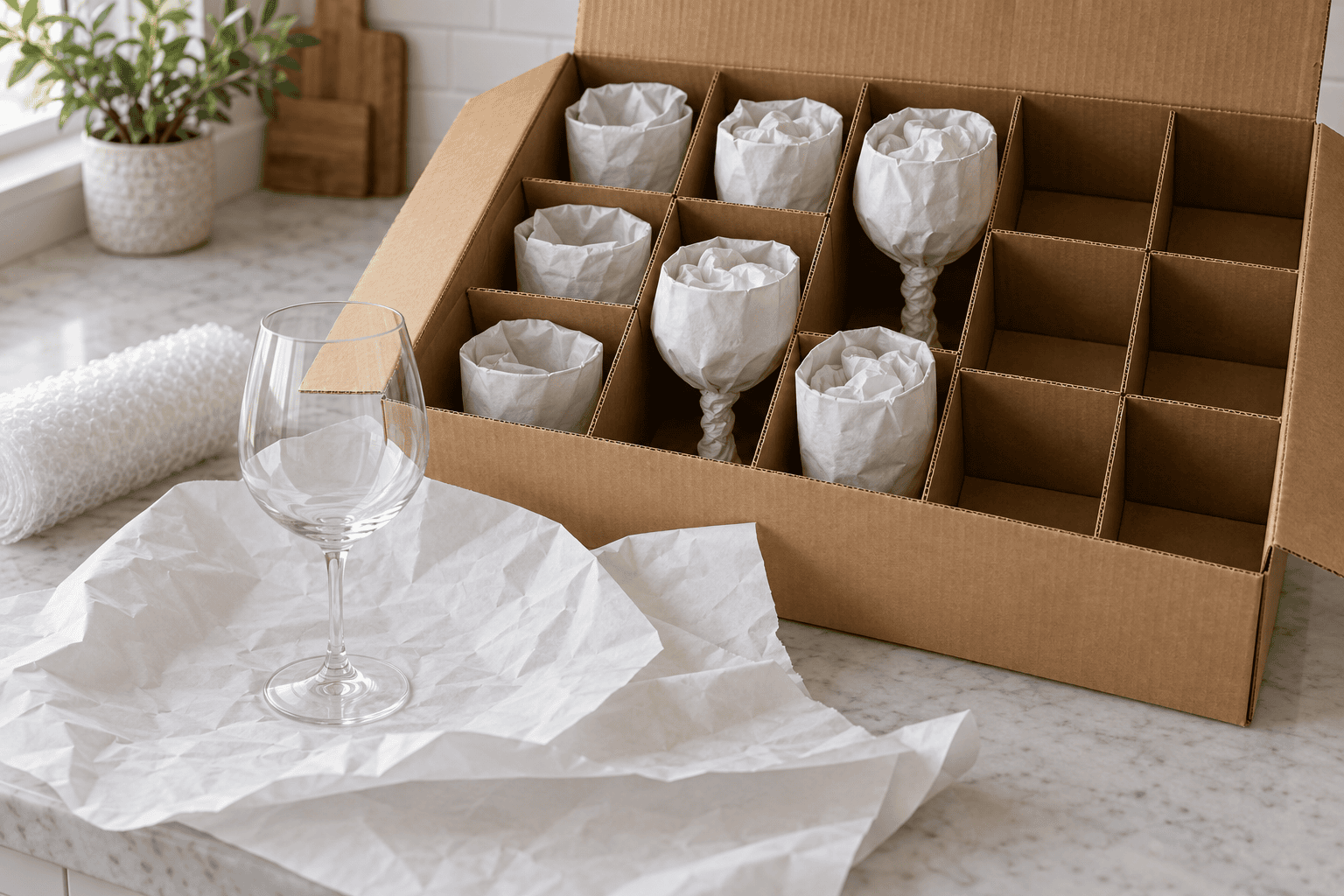
- Stuff the inside of each glass or mug with crumpled paper first, then wrap a sheet around the outside. Wrap mug handles separately with a small twist of paper before the outer wrap.
- Pack glasses upright, in cell dividers if you have them, in rows if you don’t, with heavier tumblers in the bottom layer and a paper layer before any second row.
- For wine glasses, wrap the stem on its own with a strip of paper or bubble wrap, then wrap the whole glass, and place it upright. Nothing goes on top of a row of stemware.
- Double-box crystal and anything irreplaceable: pack a small box, then set it inside a larger one with three inches of paper on every side.
Out of paper? Clean dish towels, socks and T-shirts fill gaps and wrap tumblers well enough, but they don’t replace paper on stemware, because fabric compresses and leaves the stem unsupported. The trade-off in all of this is time: a family kitchen takes two to four hours to pack properly, which is the number to weigh against having the carrier’s crew do it.
Why Packing Matters More on a Long Distance Move Than a Local One
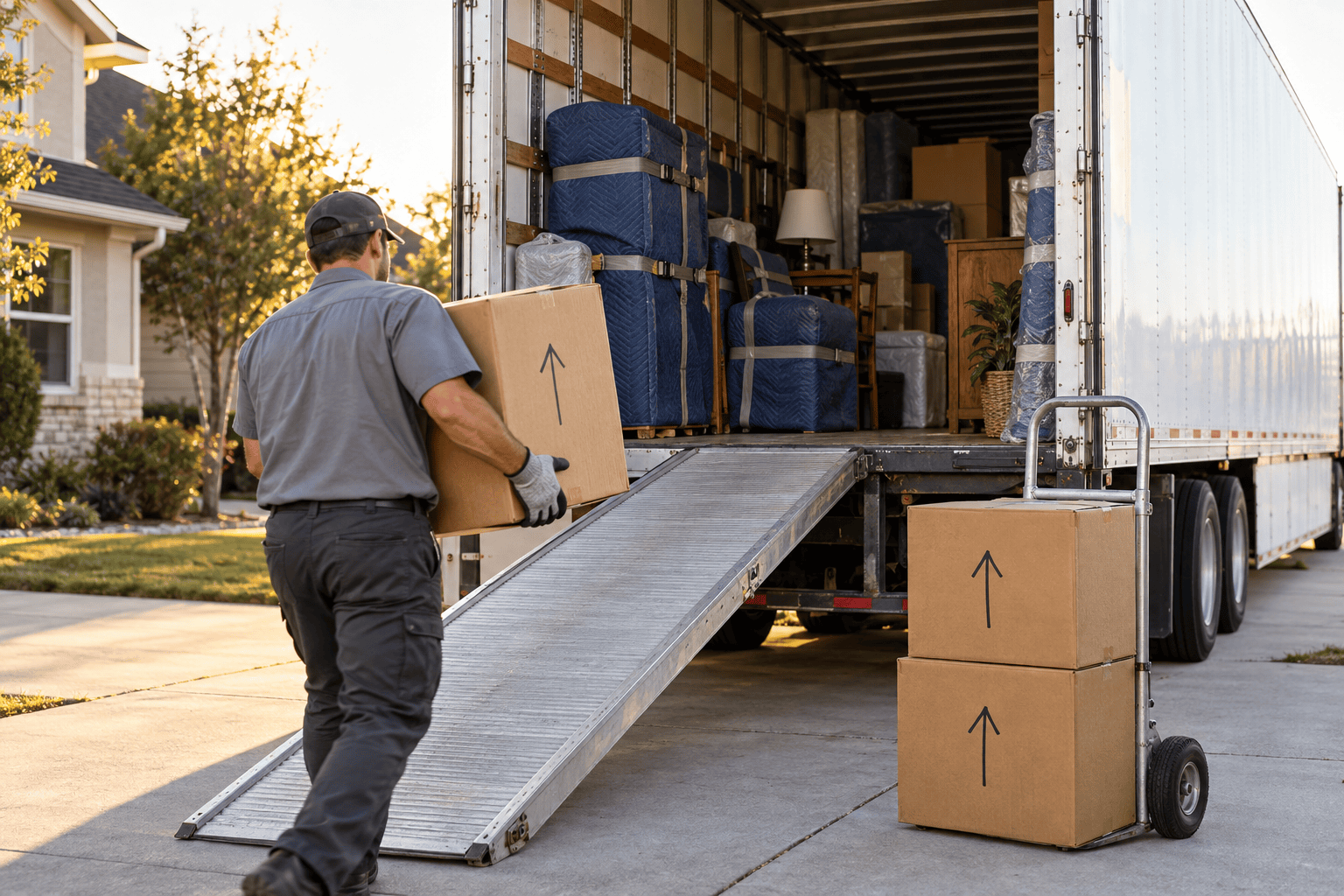
A local move puts your dish boxes on a truck for an hour. An interstate move puts them on a trailer with other households’ shipments, drives them across the country, and may transfer them to a shuttle truck at either end because a 53-foot trailer can’t reach your street. Each handoff is a chance for a badly packed box to fail, and the crew unloading it is not the crew that loaded it.
There’s also a paperwork side packing guides leave out. Hercules Moving Solutions is a licensed moving broker, DOT 3497836 and MC 1153414, and the carrier it places you with is legally responsible for your shipment. FMCSA’s liability and protection guidance says plainly that a carton you packed yourself is harder to claim on if it arrives damaged, because nobody can show whether the plate broke in transit or was loose from the start. Three numbers follow from the same rules:
- Released value protection, the free minimum every carrier must offer, pays 60 cents per pound per article. A three-pound dinner plate settles at $1.80.
- Under full value protection, the carrier can limit its liability on items worth more than $100 per pound, and FMCSA names china as an example. List a set like that on the shipping documents or it isn’t covered at that value.
- You have nine months from delivery to file a written claim, and damage noted on the inventory at delivery is far easier to prove than damage found a week later.
So the practical decision is this. Pack your everyday dishes with the method above and accept that a cracked stoneware plate is a $2 problem. For heirloom china, crystal and anything you’d file a claim over, have the carrier’s crew pack it under a full or partial packing service added to your Hercules quote, because a carrier-packed carton is the carrier’s responsibility. Our guide to what to do with heirloom china and crystal covers custom crating and when it’s worth the cost. And once the kitchen is boxed, how to pack for a long distance move takes the same approach through the rest of the house.
Frequently Asked Questions
Is it better to pack plates flat or upright?
Upright, on their edges. A plate lying flat carries the weight of every plate stacked on it, and the bottom one cracks first when the box is set down hard. On edge, each plate carries only its own weight and the paper around it absorbs side impacts. Load the box like a dishwasher rack, heaviest plates first.
Is packing paper or bubble wrap better for dishes?
Packing paper, for almost everything. It’s cheaper, wraps tighter, fills gaps, and leaves no ink behind. Bubble wrap earns its place on wine glass stems, mug handles, and as the outer layer on crystal or fine china you’re double-boxing. Wrapping every plate in bubble wrap costs more and makes the bundles too bulky to stand on edge.
How long before a move should I start packing dishes?
Start the kitchen about two weeks before load day, after the storage areas and guest rooms, and keep one place setting per person out until the last morning. A long distance move delivers inside a delivery spread rather than on a fixed date, so the essentials you keep out should cover a week, not a night.
Should I pack my own dishes or let the movers do it?
Pack your everyday dishes yourself and let the carrier’s crew pack anything you’d claim on. A carton you packed is harder to claim on under federal rules, and released value protection pays 60 cents per pound either way. Hercules Moving Solutions can add full or partial packing to your quote, so the crew handles the china.
Decide Now Whether the Kitchen Is Yours to Pack
The everyday kitchen is a two-week, four-box job: a dish box, plenty of paper, plates on edge, glasses upright. The china cabinet is a different decision, because on an interstate move what you pack yourself is also what you’ll struggle to claim on. If you’re weighing that, or you’d rather hand the whole kitchen to the carrier’s crew, ask about adding full packing to your quote or email info@herculesmovingsolutions.com, and we’ll price both versions of the move so you can compare them.