Most people who move to Hawaii say the same thing afterward. They wish someone had told them the full picture before they started packing. Not just the beaches and the sunsets, but the shipping timelines, the agricultural restrictions, the cost of a grocery run, and what it genuinely takes to settle into island life on the Big Island.
Whether you are relocating from California, Texas, Florida, or anywhere in the continental United States, moving to Hawaii is one of the most logistically complex long distance moves you will ever make. It requires a different approach than a standard cross-country relocation, different planning, different timelines, and a much more deliberate decision about what actually makes the trip.
By the time you finish reading, you will understand how shipping works, what the real costs look like, how the Big Island compares to the other islands for everyday living, what to do about your pets, and what mistakes consistently trip people up before they even board the plane.
Why Are So Many People Choosing To Relocate To Hawaii Right Now?
Hawaii has always attracted transplants, but the wave of relocations since 2020 has shifted the demographic considerably. Remote work changed the math for a lot of people. When your job no longer requires you to live within commuting distance of a specific city, Hawaii stops being a retirement dream and starts looking like a real option.
The Big Island in particular has drawn people looking for more land, lower density, and a slower pace than Oahu or Maui. Hilo and the surrounding communities on the east side offer affordable housing by Hawaiian standards. The Kona coast on the west side delivers the sunny dry weather and resort amenities many mainland transplants picture when they imagine island life.
What most people underestimate:
- The logistics of an ocean crossing for all your belongings
- How dramatically the cost of living differs by island and even by side of the island
- How long it realistically takes for a household shipment to arrive
- The strict agricultural and quarantine rules that govern what can enter Hawaii
- How different the job market is compared to major mainland metro areas
The lifestyle appeal is real. So is the complexity of getting there with your household intact.
What Makes Moving To Hawaii Different From Every Other Long Distance Move?
The fundamental difference is that Hawaii is not connected to the mainland by road. Everything you own that travels with you goes by ship or by air, and the logistics, costs, and timelines that come with ocean freight are entirely different from what applies to a standard interstate truck move.
You are not booking a moving truck that drives across the country. You are booking space in a shipping container, or a shared container, or a consolidated freight shipment. Your belongings will be loaded at a mainland port, transported across the Pacific, unloaded at a Hawaii port, and then delivered to your new address.
That process takes longer, costs more, and requires earlier planning than almost any mainland relocation. It also means you need to make deliberate decisions about what is worth shipping and what is better sold, donated, or purchased new once you arrive.
A few specifics that apply to Hawaii that do not apply to mainland moves:
- Items with soil, seeds, or plant material attached are subject to agricultural inspection and may be confiscated
- Certain wood products, fresh produce, and plants cannot be brought in at all
- Cars need to meet Hawaii emissions requirements and are subject to inspection on arrival
- Pets face strict quarantine rules that require months of preparation to handle correctly
- Island time is real, and delivery windows at your destination reflect that
How Does Shipping Your Belongings To Hawaii Actually Work?
This is where the moving to Hawaii guide conversation usually gets more detailed than people expect.
What Are Your Container Options For Shipping To Hawaii?
There are two main paths for shipping household goods to Hawaii.
The first is a full container load. You rent an entire 20-foot or 40-foot shipping container, your belongings fill it, and it travels exclusively to your destination. This is the faster, more secure option and is usually the better choice for larger households with three or more bedrooms.
The second is a less than container load, often called LCL or consolidated shipping. Your belongings share container space with other shipments going to Hawaii. You pay only for the cubic footage your shipment occupies. This is typically the more cost-effective option for smaller moves, studios, and one-bedroom apartments, but transit times tend to be longer because the container waits to fill before departing.
A few things to know about either option:
- You will need to drop your shipment at a mainland freight port or arrange drayage pickup
- Most shipments originate from Los Angeles, Long Beach, or Seattle
- Delivery at the Hawaii end involves port fees, customs, and a final leg to your address
- Transit from the mainland to Hilo or Kawaihae port on the Big Island is typically 10 to 14 days on the water, plus loading and unloading time on both ends
How Do You Ship A Car To Hawaii?
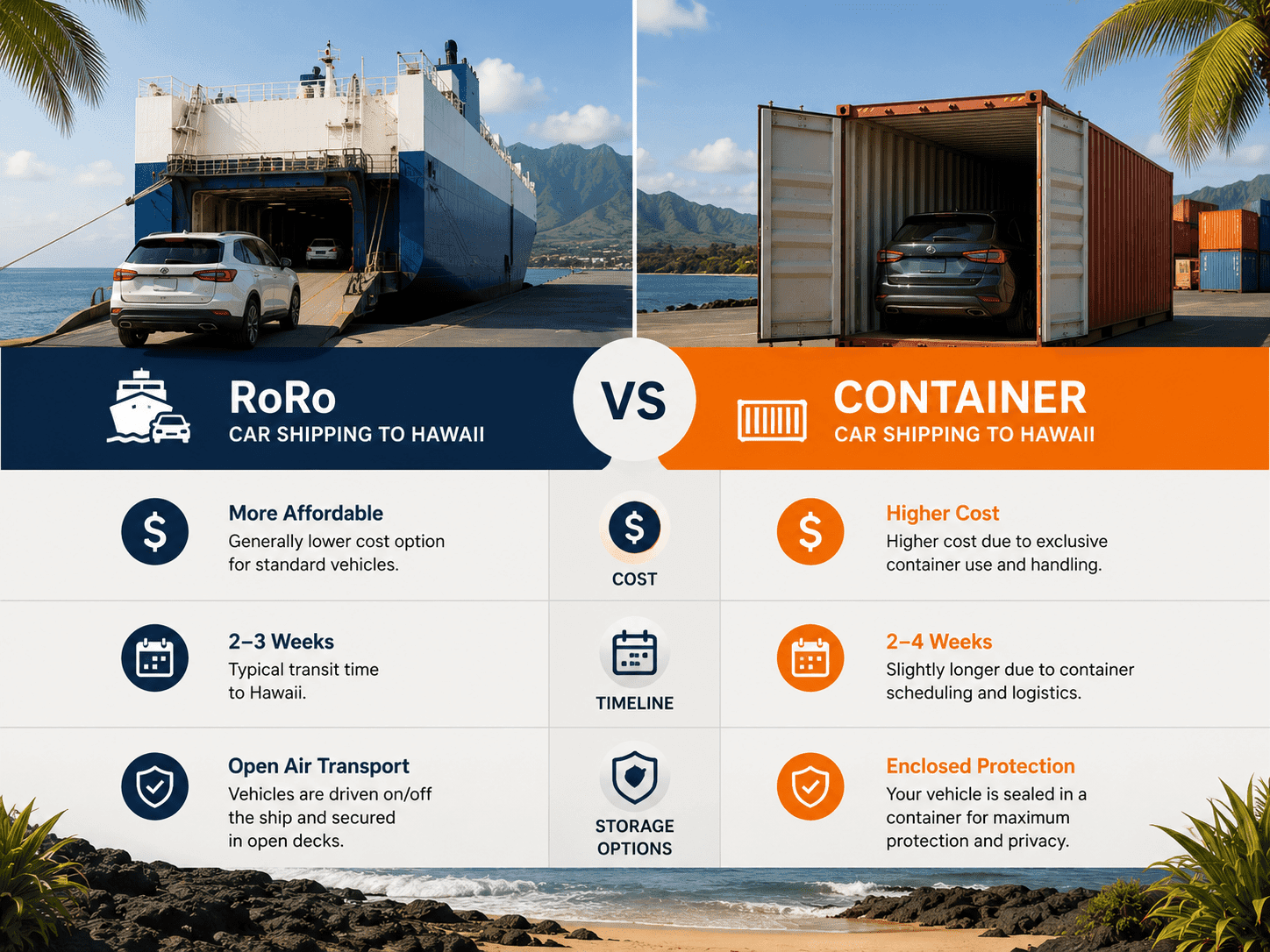
Car shipping to Hawaii goes through either RoRo service, which stands for roll-on roll-off, or container shipping.
RoRo is the more affordable method. Your vehicle is driven onto a specialized vessel, secured, and transported. The main limitation is that nothing can be stored inside the car during transit.
Container shipping costs more but allows you to pack the car with household goods up to a certain weight, which can offset the container cost somewhat. It also provides more protection for high-value or specialty vehicles.
Port of entry for the Big Island is typically Kawaihae Harbor or Hilo Harbor depending on the carrier and route. Your vehicle will go through an agricultural inspection on arrival, so make sure it is clean inside and out. Any soil, plant material, or seeds found inside can delay release significantly.
Shipping a standard sedan from the West Coast to the Big Island typically runs between $1,200 and $2,000 for RoRo and $1,800 to $3,500 for container depending on the vehicle size and container configuration.
What Does It Actually Cost To Move To Hawaii?
Real numbers for a Hawaii relocation vary considerably based on how much you are shipping, where you are departing from, and which island you are moving to. Here is a realistic framework.
Move Type | Household Size | Estimated Moving Cost |
LCL consolidated shipping | Studio or 1 bedroom | $2,500 to $5,500 |
LCL consolidated shipping | 2 bedroom | $4,500 to $8,000 |
Full 20-foot container | 2 to 3 bedroom | $6,000 to $10,000 |
Full 40-foot container | 3 to 4 bedroom | $9,000 to $16,000 |
Car shipping (RoRo, West Coast) | Standard sedan or SUV | $1,200 to $2,000 |
Car shipping (RoRo, East Coast) | Standard sedan or SUV | $2,500 to $3,800 |
Air freight (small items, urgent) | Per 100 lbs | $300 to $600+ |
Costs from the East Coast are meaningfully higher because your shipment either travels overland to a West Coast port first, or goes through a longer ocean routing.
Important additional costs to factor in that many people miss:
- Port fees and drayage at destination
- Agricultural inspection delays if items are flagged
- Temporary storage on the mainland if your Hawaii housing is not ready
- Hotel or short-term rental costs during the gap between arrival and household delivery
- First month of housing costs are often higher due to deposits and Hawaii rental market conditions
At Hercules Moving Solutions, we work with people planning Hawaii moves regularly, and what we find is that the total cost surprises most people not because of the core shipping price, but because of the downstream costs that appear when the timing does not line up perfectly. Planning for a 3 to 4 week gap between your arrival and your household delivery arriving is a reasonable buffer for most Big Island moves.
What Should You Bring And What Makes More Sense To Leave Behind?
This is genuinely one of the most important decisions in your entire move, and it is one most people do not think through carefully until they are standing in front of their furniture trying to do math.
Worth shipping to Hawaii:
- Furniture you genuinely love and would pay to replace, especially quality wood or upholstered pieces
- Electronics, appliances that fit 120V current (same as mainland), computers, cameras
- Clothing, bedding, kitchen items, and personal belongings
- Specialty or hobby equipment that is expensive to replace
- Instruments and valuables, properly packed through a professional packing service
Better sold, donated, or replaced on arrival:
- Cheap IKEA or flat-pack furniture where shipping cost exceeds replacement cost
- Cold weather clothing, heavy winter gear, bulky coats
- Gasoline-powered lawn equipment with residual fuel (restricted)
- Large appliances if they are older than 10 years, given shipping cost versus replacement value
- Extensive book or media collections unless they are genuinely irreplaceable
The humid climate on the Big Island, especially on the Hilo side, is hard on certain materials. Leather furniture, electronics without proper protection, and wood that is not treated can deteriorate faster than expected if storage or the new home does not have consistent climate control. This is worth discussing with your moving consultant before you commit to shipping items with sentimental but not practical value.
For professional packing services that protect your belongings through ocean transit, see our packing services here.
What Is The Big Island Really Like To Live On?
This is where the moving to Hawaii guide conversation has to get honest about the difference between visiting Hawaii and living there.
The Big Island is the largest island in the Hawaiian chain by land area, larger than all the other Hawaiian islands combined. It has two distinct sides that feel almost like different climates and communities.
Hilo Or Kona, Which Side Of The Big Island Is Right For You?
The east side, centered around Hilo, is wetter, greener, and significantly more affordable. Hilo is a genuine small city with a farmers market, a state university, local restaurants and shops, and a strong community feel. Rent and home prices are considerably lower than Kona. If budget is a major factor and you work remotely or in healthcare, education, or government, Hilo and surrounding communities like Keaau, Pahoa, or Mountain View tend to work well for transplants.
The west side, centered around Kailua-Kona and the South Kohala resort corridor, is sunnier, drier, and more expensive. Kona has a stronger tourism economy, more restaurants and retail, and a larger expat and transplant community. Home prices and rental rates are notably higher, but the trade-off is near-daily sunshine, proximity to white sand beaches, and a more developed amenity infrastructure.
North Kohala, Waimea, and the Hamakua coast offer a middle ground between the two, with cooler temperatures at elevation, stunning landscapes, and a more rural character.
What catches many mainland transplants off guard:
- Grocery prices are significantly higher than the mainland, 20 to 60 percent more depending on the item
- Power outages from weather or volcanic events can last longer than most mainland residents are used to
- The volcanic landscape on the east side means some areas have poor air quality days from volcanic emissions called vog
- Distances are longer than they appear on a map because of winding roads and speed limits
- Island infrastructure for medical specialists, certain retail, and services requires Oahu trips for anything complex
How Much Does It Cost To Live On The Big Island Month To Month?
Hawaii’s cost of living is consistently among the highest in the United States, but the Big Island is meaningfully more affordable than Oahu or Maui. Here is a realistic monthly picture for a couple or small family.
Expense | Hilo / East Side | Kona / West Side |
1 bedroom rent | $1,400 to $2,000 | $2,000 to $2,800 |
2 bedroom rent | $1,800 to $2,800 | $2,600 to $4,000 |
Groceries (2 people) | $700 to $1,100 | $800 to $1,200 |
Utilities (electric, water) | $250 to $450 | $200 to $400 |
Gas (per gallon, 2026 avg.) | $4.40 to $5.20 | $4.40 to $5.20 |
Internet | $80 to $150 | $80 to $150 |
Health insurance | Varies significantly by employer | Varies |
Hawaii has a state income tax rate that ranks among the higher ones nationally, with rates running from 1.4 to 11 percent. Property taxes are actually relatively low compared to many mainland states, which is one reason home ownership on the Big Island makes financial sense for some transplants over time.
The electricity bill surprises many newcomers. Hawaiian Electric runs on oil-generated power, and rates are among the highest in the country. Solar adoption is very high for this reason, and if you are purchasing a home, a property with an existing photovoltaic system is a meaningful financial asset.
What Does The Job Market Look Like On The Big Island?
This is one of the honest conversations most moving guides avoid. The Big Island job market is significantly smaller and less diverse than what most mainland professionals are used to.
Strong sectors include:
- Tourism and hospitality, especially on the Kona side and resort corridor
- Healthcare, particularly through Hilo Medical Center and Kona Community Hospital
- Education through University of Hawaii at Hilo and the Department of Education
- State and county government positions
- Real estate and property management
- Astronomy and scientific research around Mauna Kea
Remote work is increasingly how mainland professionals make the Big Island work financially. If you are a software developer, digital marketer, consultant, writer, or any professional whose work is location-independent, the island becomes considerably more viable.
The realistic advice is this. Do not move to the Big Island without a confirmed income source unless you have significant savings and a clear path to income on the island. Housing deposits alone, combined with the gap period before your household arrives, can run $5,000 to $10,000 in upfront costs before you are settled.
What Happens To Your Pets When You Move To Hawaii?
Hawaii is one of the few places in the United States with a strict rabies-free status, and the state takes its agricultural and biological protections seriously. Bringing pets to Hawaii requires advance planning that most people do not start early enough.
The Hawaii Department of Agriculture runs a mandatory animal quarantine program. The good news is that dogs and cats can qualify for a 5-day or less quarantine if all requirements are met in advance. The program requires:
- Two rabies vaccinations given at least 30 days apart
- A rabies antibody titer test showing adequate immunity levels
- A waiting period of at least 90 days after the titer test is drawn
- Microchipping before the second rabies vaccination
- USDA-endorsed health certificate issued within 14 days of arrival
- Direct flight into Honolulu International Airport (connections may cause complications)
If any requirement is not completed in the correct order or within the required timeframes, the 5-day or less program does not apply and your pet may be held for up to 120 days in the quarantine facility at your cost.
Start the pet quarantine process at least 6 months before your intended move date. Check current requirements directly through the Hawaii Department of Agriculture as program requirements can update.
Planning Your Hawaii Move? Get $300 Off Your Relocation
Moving to Hawaii is a major undertaking, and the broker you work with makes a real difference in how smoothly the coordination goes. At Hercules Moving Solutions, we have handled over 1,523 successful moves, including Hawaii relocations, connecting our clients with licensed, vetted carriers who handle ocean freight shipping from the mainland.
Right now, you can get $300 off when moving 200 miles or more out of state, which includes all Hawaii relocations. Get a free instant quote here and let us put together a package that matches your timeline, your household size, and your Big Island destination.
What Mistakes Do People Make When Moving To Hawaii?
You probably came across some of these in your own research, but there are a few that come up repeatedly with clients who moved to Hawaii without a full picture.
Underestimating the timeline. People plan as if Hawaii is a standard 2-week move. Between container booking lead times, ocean transit, port processing, and delivery on the Big Island, 6 to 10 weeks from pickup to delivery at your new address is realistic for many households. Build your housing plan, storage needs, and temporary living arrangements around this window, not around a best-case scenario.
Shipping everything without evaluating it first. Shipping weight and volume directly drive your cost. Many people could cut their shipping bill by 20 to 30 percent by decluttering before packing. Furniture that cost $200 can cost $400 to ship and $600 to replace. The math does not always favor bringing it.
Not researching specific Big Island areas before signing a lease. Signing a lease in Puna because it was affordable, then discovering it is a 45-minute drive from the nearest full grocery store, is a reality check that comes up often. Research the specific community, not just the island.
Ignoring agricultural restrictions until packing day. Items flagged at agricultural inspection on arrival can delay your entire shipment release. Know what cannot come in before you pack it. Common problem items include certain houseplants, wood with bark, citrus, soil, and products containing specific materials.
Not reading their rights as a moving customer. The FMCSA provides a consumer guide on your rights during interstate and international moves. Read it before you sign any contract, and understand what binding versus non-binding estimates mean for your final bill. Our guide on how to avoid long distance moving scams covers this in detail.
What Should You Do In The First 30 Days After Arriving?
Arriving in Hawaii before your household shipment is common and actually works well if you plan for it. Here is what to prioritize once you land.
- Set up a PO Box or local address if your permanent housing is not confirmed
- Open a local bank account if your current bank has no Hawaii branches
- Get your Hawaii driver’s license, required within 90 days of establishing residency
- Register your vehicle once it clears port and inspection
- Register with the county for real property tax purposes if purchasing
- Enroll children in school through the Hawaii Department of Education which operates on a statewide system
- Find your nearest emergency shelter and understand vog, volcanic, and weather alert systems
- Explore the neighborhood you landed in before committing to any long-term decisions
Arriving a week or two before your household shipment also gives you time to prepare the new space, figure out any furniture you need to purchase locally, and settle into the rhythm of the island before the chaos of move-in day.
You’re Ready To Move To Hawaii, Here’s How We Can Help
The logistics of a Hawaii move are manageable when you have the right team coordinating them. Hercules Moving Solutions connects you with licensed, vetted carriers who handle ocean freight, container shipping, and full-service packing specifically for moves like this.
With over 1,523 successful moves, $300 off for relocations over 200 miles, and tailored packages that fit your specific household size and timeline, we take the coordination off your plate so you can focus on the actual transition.
Visit our Hawaii Movers page for more details on how we handle Hawaii relocations specifically, or get your free quote now.
Frequently Asked Questions About Moving To Hawaii
How Much Does It Cost To Move To Hawaii From The Mainland?
Most people moving a 2 to 3 bedroom household from the West Coast to Hawaii spend between $6,000 and $14,000 on the move itself, excluding car shipping, temporary housing, and first-month living expenses. Moves originating from the East Coast usually cost more because of the added transport distance to a West Coast port or longer ocean shipping routes. Smaller moves using consolidated LCL shipping can sometimes stay under $5,000 for studio or one-bedroom households.
Is It Worth Moving Everything Or Should You Just Start Fresh In Hawaii?
That depends on the value and condition of your belongings. High-quality furniture, electronics, personal items, and anything with sentimental value are usually worth shipping. Older furniture, inexpensive appliances, and bulky items that cost more to move than replace are often better sold before relocating. Most people find the best approach is a balance between shipping important items and purchasing replacements locally after arrival.
How Long Does It Take For Your Belongings To Arrive In Hawaii?
Once your shipment leaves a West Coast port, ocean transit to the Big Island typically takes between 10 and 21 days depending on the carrier and routing schedule. Including origin loading, port processing, and final delivery, most households should expect a total timeline of 3 to 6 weeks from mainland pickup to delivery at their Hawaii residence.
What Cannot Be Shipped Or Brought Into Hawaii?
Hawaii has strict agricultural regulations designed to protect the islands’ ecosystem. Commonly restricted or inspected items include fresh fruits and vegetables, plants with roots or soil attached, certain wood products, citrus items, and anything containing live insects or larvae. Shipping prohibited items can delay your entire move, so it’s important to review current restrictions through the Hawaii Department of Agriculture before packing.
Do You Have To Quarantine Your Pet When Moving To Hawaii?
Yes. All dogs and cats entering Hawaii must meet quarantine requirements. However, pets that complete the state’s approved 5-Day-Or-Less program requirements correctly and on time can usually qualify for a short holding period instead of the full quarantine. Missing any requirement may result in up to 120 days in the state quarantine facility. Most pet owners should begin preparations at least 6 months before moving.
Is The Big Island A Good Place To Relocate Compared To Oahu Or Maui?
For people looking for lower housing costs, more land, and a quieter pace of life, the Big Island is often the most appealing option. Oahu offers more urban conveniences, infrastructure, and job opportunities, but also comes with significantly higher housing costs and heavier traffic. Maui sits somewhere in the middle. The Big Island is especially popular with remote workers, retirees, agricultural buyers, and anyone seeking more space without Oahu-level pricing.
How Different Is The Cost Of Living On The Big Island From The Mainland?
Groceries on the Big Island generally cost 20% to 60% more than mainland averages depending on the product. Electricity prices are also significantly higher, which is one reason solar power is so common throughout Hawaii. Gas prices are typically about $1.00 to $1.50 per gallon higher than many mainland markets. However, housing costs in Hilo and many rural east Hawaii communities can still compare favorably to mid-sized mainland cities, helping offset some of the increased day-to-day expenses.
How Do You Ship A Car To Hawaii?
Most vehicles are shipped to Hawaii using either RoRo (Roll-on/Roll-off) service or container shipping. RoRo is usually the most affordable option, with standard West Coast vehicle shipments commonly costing between $1,200 and $2,000. Container shipping costs more but may allow limited personal belongings inside the vehicle depending on weight restrictions. All vehicles are inspected for agricultural compliance upon arrival, so the interior and exterior should be thoroughly cleaned and free of dirt, plants, or debris before shipping.
Does Hercules Moving Solutions Handle Hawaii Moves?
Yes. We coordinate Hawaii relocations through our Hawaii Movers service, connecting you with licensed ocean freight carriers and providing a tailored moving package that covers packing, storage, and transportation based on your household size and timeline. You also get $300 off when moving over 200 miles out of state, which covers all Hawaii relocations. Get a free quote here.
What Is The Hardest Part Of Moving To Hawaii That Nobody Warns You About?
Most Hawaii veterans will tell you it is the combination of the waiting period and the cost reality. You arrive with excitement and no furniture, living out of suitcases for weeks while your shipment crosses the Pacific. Your grocery bill is immediately 30 to 40 percent higher than expected. The isolation of island life, beautiful as it is, takes adjustment. Going back to the mainland for a medical specialist, a specific product, or to visit family is a $500 to $1,000 round trip rather than a drive. These are manageable realities, but knowing them in advance makes the transition considerably smoother.
Ready To Start Planning Your Big Island Relocation?
Moving to Hawaii is genuinely one of the most rewarding things you can do if you go into it with clear expectations and a solid plan. The complexity is real, but so is the lifestyle on the other side of it.
The people who make the transition well are the ones who did not rush the planning, made thoughtful decisions about what to ship, prepared their pets months in advance, and worked with a moving team that understood the Hawaii relocation process from start to finish.
Hercules Moving Solutions has the experience, the carrier network, and the tailored packages to make this move work the way it should. Browse our long distance moving solutions, read through our customer reviews from people who have been exactly where you are, and get your free quote when you are ready to move forward.