Moving to Alaska or Hawaii is not the same as moving to the next state over, and that surprises a lot of people. There is no straight highway you can load a truck onto and drive from Texas to Honolulu, and the road to Anchorage runs through another country. The ocean, the border, and the distance change everything about how your belongings travel, what it costs, and how long you wait to see your couch again.
If you are planning one of these moves, you have probably already noticed that normal moving quotes do not seem to apply, and that the answers you find online are all over the place. That is because Alaska and Hawaii relocations involve ocean freight, port logistics, and carriers most people have never dealt with before.
In this guide you will learn exactly how your stuff gets to each state, what a realistic move costs in 2026, the fees that catch people off guard, how long transit really takes, and when it makes more sense to sell things off rather than ship them. By the end you will be able to plan with real numbers instead of guesses.
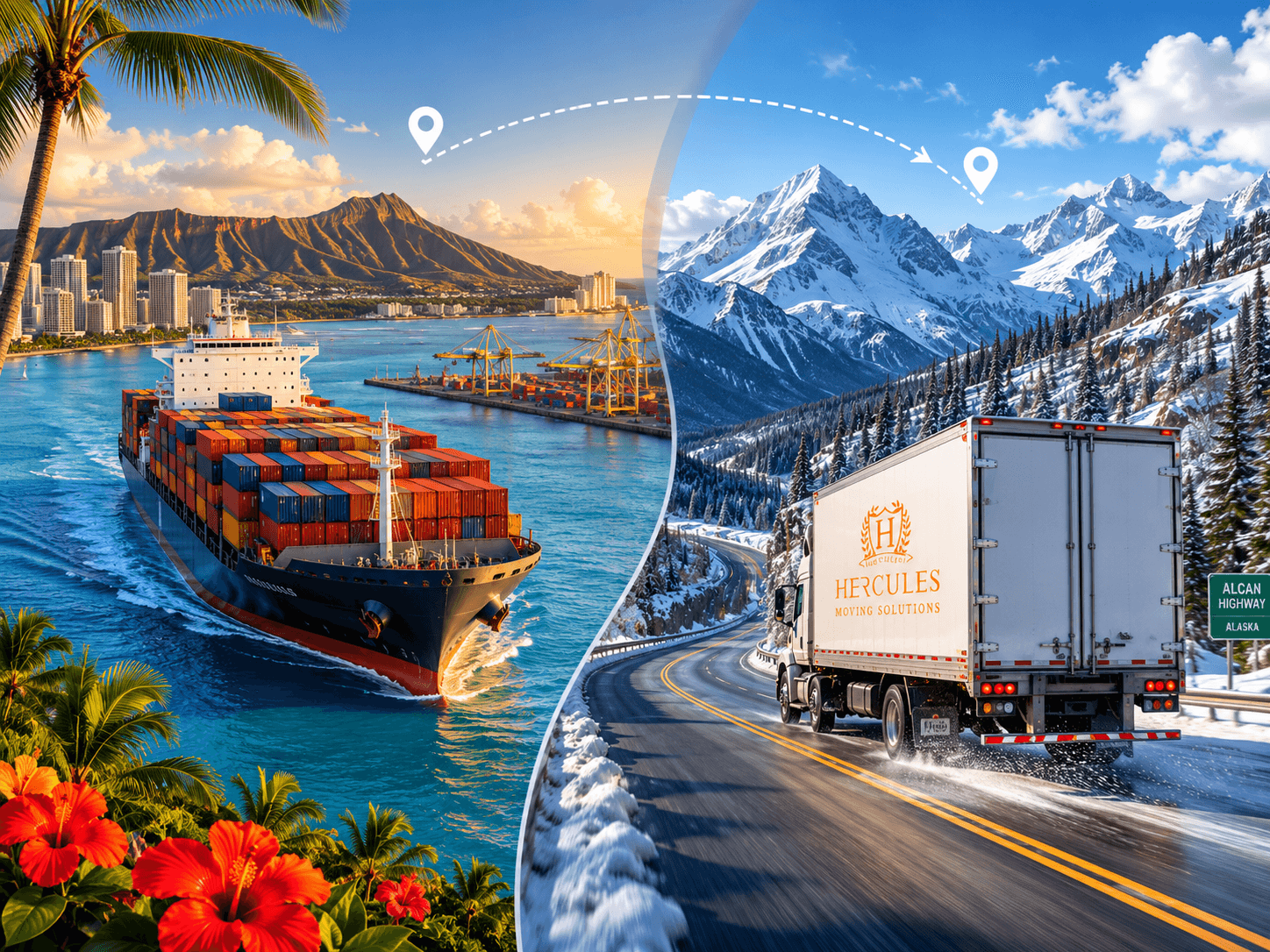
Why Are Alaska And Hawaii Moves So Different From A Normal Long Distance Move?
The short answer is that you cannot drive a moving van door to door the way you can between two mainland states. Both moves involve crossing a barrier that a standard interstate move never touches, and that barrier dictates the carriers, the cost, and the timeline.
For Hawaii, the barrier is roughly 2,500 miles of open ocean. Your belongings have to be loaded into a shipping container, trucked to a West Coast port, and sailed across by an ocean carrier. For Alaska, the barrier is geography and an international border, since the only road route runs about 2,000 miles through Canada to reach Anchorage.
Here is what that means in practice:
- Your move is usually handled more like an overseas relocation than a typical cross country one
- You are often paying for two or three legs of transport, not one truck ride
- Timelines depend on sailing schedules and weather, not just driving distance
- The carriers involved are specialists, not the same vans that handle a move from Ohio to Florida
This is exactly why working with someone who coordinates these moves regularly matters. At Hercules Moving Solutions, we match your move with vetted carriers who run these routes every week, so the logistics are handled by people who already know the ports, the paperwork, and the pitfalls.
How Do You Actually Move Your Belongings To Hawaii?
Almost everything you own travels to Hawaii by sea. The most common path is loading your belongings into an ocean shipping container that sails from a West Coast port, with the two dominant carriers being Matson and Pasha Hawaii.
You generally have three ways to ship household goods to Hawaii, and the right one depends on how much you are bringing.
- Full container load, or FCL. You get an entire 20 foot or 40 foot container to yourself. This is the most cost effective choice once you are moving a two bedroom home or larger, since you are filling space you already paid for.
- Less than container load, or consolidated freight. Your belongings share a container with other shipments through a freight forwarder. The price per item is lower, but you wait longer because the carrier consolidates loads before sailing.
- Mail or parcel shipping. For a very small move, sending boxes through USPS, UPS, or FedEx can actually be simpler, though it adds up quickly past a few boxes.
There is also the question of how far the carrier handles your shipment. Port to port means you arrange trucking to the departure port and pickup at the Hawaii port yourself, which is cheaper. Door to door means the move is handled from your old home to your new one, which is easier but adds cost.
If you are bringing a vehicle, that is usually a separate booking. Cars cross on the same ocean carriers, and Pasha is often the more economical option for vehicles while Matson tends to be faster for household goods. Our team helps you weigh these tradeoffs instead of leaving you to decode carrier tariffs on your own. You can see how we structure island moves on our Hawaii movers page.
How Do You Move To Alaska When You Cannot Just Drive A Moving Truck?
Alaska gives you more options than Hawaii because there is technically a road, but each option comes with real tradeoffs. Most full household moves today are handled much like an international shipment, with your goods containerized, trucked to a West Coast port, and sent north by sea.
Here are the main ways people get their belongings to Alaska:
- Ocean freight and barge. Your container is shipped from a port like Tacoma or Seattle to Alaska ports such as Anchorage or Whittier, then delivered locally. This carries the bulk of most household moves.
- Driving the Alcan Highway. The legendary route runs roughly 2,000 miles from the lower 48 through Canada to Anchorage. It is doable, but it requires a passport, customs paperwork, emergency gear, and a tolerance for long remote stretches.
- The Alaska Marine Highway. This ferry system runs from Bellingham, Washington, and lets you bring your vehicle and a small trailer without putting thousands of miles on it.
- Moving containers. Portable container services let you load at your own pace, then handle the transport, with the local delivery handled once it arrives.
One thing worth knowing is that the old door to door moving van service to Alaska, sometimes called thru van service, has become much less common. That is why most Alaska moves now route through a port. Remote destinations in northern and western Alaska also cost more than Anchorage, since some towns are reached by gravel roads and limited carrier coverage. Our Alaska movers page walks through how we coordinate these routes.
How Much Does It Cost To Move To Hawaii Or Alaska?
Both moves cost more than a typical mainland relocation, and the single biggest driver is the ocean leg. As a rough guide, a household move to either state commonly lands somewhere between $4,000 and $16,000 or more, depending on how much you ship and how far inland you start.
Here are realistic 2026 ranges for Hawaii, keeping in mind these figures center on the ocean shipping portion.
|
Move Size |
Typical Hawaii Cost Range |
|
Studio or 1 bedroom |
$3,500 to $7,000 |
|
2 bedroom home |
$6,000 to $10,000 |
|
3 to 4 bedroom home |
$9,000 to $16,000+ |
|
Vehicle (standard car) |
$1,200 to $1,700 |
And here are comparable ranges for Alaska.
|
Move Size |
Typical Alaska Cost Range |
|
Studio or 1 bedroom |
$3,500 to $6,000 |
|
2 bedroom home |
$6,000 to $10,000 |
|
3 to 4 bedroom home |
$10,000 to $15,000+ |
|
Vehicle (standard car) |
$1,500 to $2,500 |
[Comparison Graphic: Side-by-side bar chart of Alaska vs Hawaii move costs by home size]
A few things shape where you land in those ranges:
- Where you start. Beginning on the West Coast is cheaper. Starting in the Midwest or on the East Coast adds significant cross country trucking before your goods ever reach a port.
- How much you bring. Ocean shipping is priced on container space or weight, so every box matters more than on a mainland move.
- Port to port versus door to door. Full service convenience commonly adds a few thousand dollars over handling the port legs yourself.
- Destination. Honolulu and Anchorage are straightforward. Neighbor islands and remote Alaska towns add handling and delivery fees.
- Season. Peak summer demand and winter weather can both push prices and timelines.
If you would rather not guess which of these factors apply to your situation, that is exactly what a real quote is for. You can request a free moving quote and get a number built around your actual home size, origin, and destination instead of a wide online range.
What Hidden Costs Catch People Off Guard?
The sticker price you first hear is rarely the final number, and island and Alaska moves have surcharges that mainland moves simply do not. Knowing them ahead of time keeps your budget honest.
- Inland trucking to the port. If you are not near a West Coast port, getting your container there can add a substantial trucking charge before the ocean leg even begins.
- Fuel and bunker surcharges. Ocean carriers adjust pricing based on fuel costs, and that adjustment rides on top of the base rate.
- Hawaii invasive species and wharfage fees. Shipments into Hawaii carry agricultural assessments, and neighbor island ports add wharfage charges.
- Port and terminal handling. Drop off, pickup, and storage at the port can all carry fees depending on the carrier and your timing.
- Door to door upcharge. Convenience is worth paying for, but it is a real line item, not a freebie.
- The quarter tank rule for vehicles. Cars shipped by barge generally must have no more than a quarter tank of fuel for safety, which is a small detail that trips people up at drop off.
- Storage between legs. If your new place is not ready, short or long term storage bridges the gap, and that is worth planning for in advance.
This is the same category of surprise we cover in our guide on hidden fees in long distance moving quotes, and it applies double when an ocean carrier is involved.
How Long Does Shipping To Alaska Or Hawaii Take?
Plan on a few days to a few weeks of transit once your shipment sails, plus the time it takes to get your goods to and from the ports. Ocean transit itself is often faster than people expect, but the full door to door window is longer because of scheduling.
For Hawaii, a container leaving a West Coast port can reach the islands in roughly a week, with the total move stretching longer when you factor in trucking to the port and final delivery. Consolidated freight takes longer because the carrier waits to fill the container. For Alaska, transit commonly runs about 7 to 14 days once shipped, and barge schedules or winter weather can extend that.
The practical takeaways are simple:
- Book early, ideally at least a month ahead, to lock in sailing dates
- Expect a delivery window rather than a single guaranteed day
- Keep a small shipment of essentials with you, since you will likely arrive before your container does
- Track your vessel before you fly out so your expectations match reality
If timelines are your main worry, our breakdown of how long a long distance move takes gives helpful context, with the ocean leg layered on top.
Should You Ship Everything Or Sell And Restart?
For long ocean moves, the honest answer is that some of your belongings are not worth the freight. Because you are paying by space or weight, low value and bulky items often cost more to ship than to replace at your destination.
A useful way to think about it is to compare the cost of shipping an item against the cost of buying it again where you land.
|
Item Type |
Usually Worth Shipping |
Often Better To Replace |
|
Quality furniture and heirlooms |
Yes |
|
|
Specialty and high value items |
Yes |
|
|
Everyday dressers and bookshelves |
Sometimes |
Sometimes |
|
Cheap particleboard furniture |
|
Yes |
|
Old appliances |
|
Yes |
|
Bulky low value items |
|
Yes |
What we typically find is that people save real money by shipping the things that matter and letting go of the things they only kept out of habit. Downsizing before an ocean move is not just tidy, it directly lowers your container size and your bill.
What Should You Never Put In An Ocean Container?
Some items are restricted, some are unsafe, and some are simply not allowed into the destination. Getting this wrong can mean delays, fines, or a rejected shipment.
- Hazardous materials. Propane tanks, fuels, aerosols, paint, and similar items are prohibited on ocean shipments.
- Plants and certain produce. Hawaii enforces strict agricultural rules to protect against invasive species, so live plants and some foods are restricted.
- Perishable food. It will not survive the transit and can attract pests.
- Important documents and valuables. Passports, jewelry, and irreplaceable papers should travel with you, not in the container.
Pets are a separate process entirely and are never shipped in a household container. Hawaii in particular has detailed pet entry and quarantine requirements through its Department of Agriculture, so that planning should start early and run on its own track.
What Mistakes Do People Make With Island And Alaska Moves?
A few avoidable missteps account for most of the stress and overspending we see on these moves.
- Treating it like a normal move. Booking a standard interstate quote and assuming it covers the ocean leg leads to sticker shock later.
- Waiting too long to book. Sailing schedules fill up, and late booking limits your dates and raises your cost.
- Shipping things that should be sold. Paying ocean freight on cheap furniture rarely makes sense.
- Ignoring the inland leg. People focus on the ocean price and forget the cost of getting goods to and from the ports.
- Skipping the essentials box. Arriving before your container with nothing for the first week is a rough start.
- Choosing on price alone. The cheapest quote often hides fees or comes from a carrier with a thin track record, which is why vetting matters.
Our guide on how to choose a long distance moving company is worth reading before you commit, since the stakes are higher when an ocean carrier is involved.
How Hercules Moving Solutions Handles Alaska And Hawaii Relocations
At Hercules Moving Solutions, we have coordinated enough island and Alaska moves to know where they go sideways, and we built our process to keep yours from doing that. As a licensed moving broker, our job is to match your move with vetted, FMCSA authorized carriers who actually run these routes, then keep the whole thing organized from your old door to your new one.
Here is what working with our team looks like for these moves:
- Tailored packages built around your home size, origin, destination, and budget, not a one size fits all rate
- Carrier matching with movers experienced in ocean freight and Alaska routes, so your shipment is in capable hands
- Packing and storage through our packing services and storage solutions, which matter when your goods sit between transport legs
- Specialty item handling for pianos, fragile pieces, and high value belongings through our specialty items service
- Military moves with discounts for active and retired personnel, a common need for both Alaska and Hawaii relocations
Many clients come to us after getting a confusing quote elsewhere that buried the ocean fees or never mentioned them at all. What we do differently is lay out the full picture, coordinate the carriers, and stay reachable while your belongings are in transit.
Ready To Plan Your Alaska Or Hawaii Move The Smart Way?
An ocean move has more moving parts than a typical relocation, but it does not have to be stressful when the logistics are handled by people who do this regularly. The earlier you start, the more dates and savings are available to you.
Call Hercules Moving Solutions at (800) 991-0973 or request your free quote online, and we will build a real plan around your home, your timeline, and your budget, then match you with the right carrier to get you there.
Frequently Asked Questions
How much does it cost to move to Hawaii from the mainland?
A full household move to Hawaii commonly runs between about $3,500 for a small studio shipment and $16,000 or more for a large home, with the ocean container being the biggest cost. Starting far from a West Coast port and choosing door to door service both push the number higher, so an accurate quote depends on your home size, origin, and destination.
What is the cheapest way to move to Alaska?
For most people, the most economical options are shipping belongings by ocean freight or barge from a West Coast port, or using a portable moving container and handling the loading yourself. Driving the Alcan Highway can save money if you are already nearby and traveling light, but fuel, lodging, and time add up over 2,000 miles.
Can I just drive a moving truck to Alaska?
You can drive to Alaska, but the route runs about 2,000 miles through Canada, which means you need a valid passport, customs paperwork, and emergency gear for remote stretches. Because of this, most full household moves are now containerized and shipped by sea rather than driven, with a local mover handling final delivery.
How long does it take to ship household goods to Hawaii or Alaska?
Ocean transit to Hawaii from a West Coast port is often around a week, while Alaska shipments typically take about 7 to 14 days once sailed. The full door to door timeline is longer because it includes trucking to and from the ports, plus any consolidation or weather delays, so booking early and planning for a delivery window is smart.
Do I ship my car separately when moving to Hawaii or Alaska?
In most cases yes. Vehicles usually travel as a separate booking on an ocean carrier, costing roughly $1,200 to $1,700 to Hawaii and $1,500 to $2,500 to Alaska for a standard car. If your car ships by barge, it generally needs no more than a quarter tank of fuel for safety.
Is it worth shipping all my furniture or should I sell it?
Ship the things that hold real value, like quality furniture, heirlooms, and specialty items, and consider replacing cheap or bulky low value pieces at your destination. Because ocean shipping is priced on space and weight, paying freight on inexpensive furniture often costs more than buying it new after you arrive.
What items cannot be shipped in an ocean container?
Hazardous materials like propane, fuel, aerosols, and paint are prohibited, and perishable food does not survive transit. Hawaii also restricts live plants and certain produce due to invasive species rules. Important documents, jewelry, and pets should travel with you and never go in the container.
Why are Alaska and Hawaii moves more expensive than mainland moves?
Both moves cross a barrier a normal move never does, which means ocean freight, port handling, fuel surcharges, and often multiple legs of transport. Roughly the majority of the cost ties back to the ocean or specialized transport portion, which is why these moves price higher than a comparable cross country move.
When should I book my Alaska or Hawaii move?
Book as early as you can, ideally at least a month ahead and earlier during the busy summer season. Sailing schedules and carrier availability fill up, so booking early gives you better dates, better pricing, and more time to handle vehicle shipping and any pet requirements.
Do you handle military moves to Alaska and Hawaii?
Yes. Military relocations to both states are common, and we offer discounts for active and retired personnel. These moves often involve tight timelines and vehicle shipping, which our carrier network is set up to handle.
Your Island Or Frontier Move Does Not Have To Be Overwhelming
Moving to Alaska or Hawaii is a bigger logistical lift than a mainland move, but it is very manageable once you understand how the ocean leg works, what it costs, and where the hidden fees hide. The people who have the smoothest experience are the ones who plan early, ship smart, and let an experienced team coordinate the carriers.
That is the part we handle. Call Hercules Moving Solutions at (800) 991-0973 or request your free quote, and we will turn a complicated ocean move into a clear plan with a real number attached.